What we got wrong
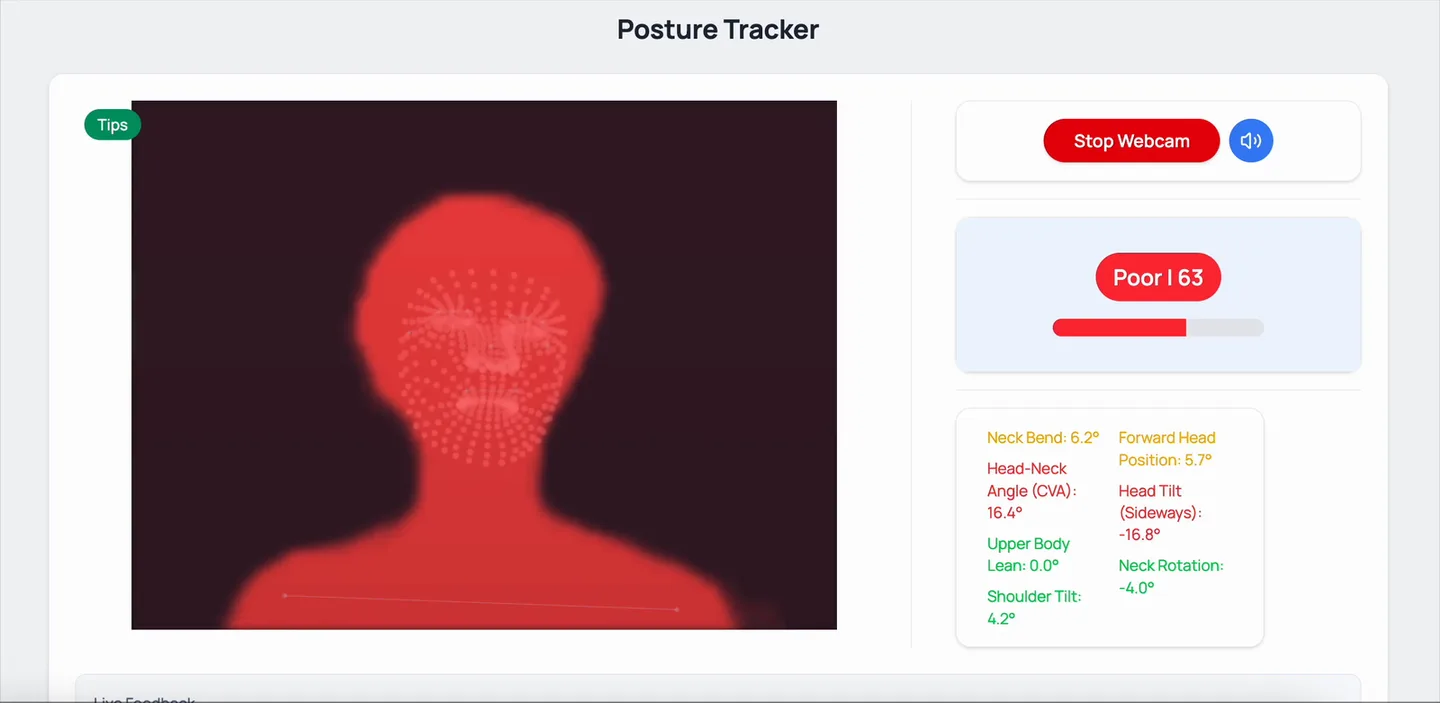
The old SitSense was a good measuring instrument bolted to a bad reason to return. It read seven posture metrics off your webcam several times a second and it was accurate. Then it took all that and handed you a verdict.
A live score out of 100, updating while you worked. An eleven-tier animal ranking that, at the bottom, called you a Shrimp. A public leaderboard with your real name on it. Points that went negative when you slouched. A streak that broke overnight and sent you an email about it in the morning.
Roughly 84% of people never came back for a second day. For a long time we read that as a features problem and kept building. It was not a features problem. Every loud surface in the product delivered a judgement about your body, and nobody opens an app daily to be told they are doing badly at sitting. The instrument was fine. The relationship was the thing that did not exist.
What we tried first
The first rebuild kept a currency and just renamed it. Points became Glow, which you accumulated by sitting well and spent to send your companion out exploring at night. It worked, and it was still a scoreboard wearing a costume. If a number goes up when you are good, you have built a grade regardless of what you call it.
The second idea was a day you could close — a target you hit, a satisfying ring completing. We cut it for the same reason, and because a target you can miss is a streak with extra steps.
The third was Air: breaks as a currency you saved up and spent. That one we cut because, written down, paying yourself to stand up is a slightly absurd thing to ask a person to do.
What survived all three was the observation underneath them. Sitting well should produce something, and that something should be spent immediately on somebody else rather than banked for yourself. Once nothing is banked, there is nothing to display, and once nothing is displayed there is no grade. The daily cap survived too — it is the part that actually protects your body — but it is invisible, and it means sitting for ten hours earns exactly as much as sitting well for an ordinary one.
How it works now
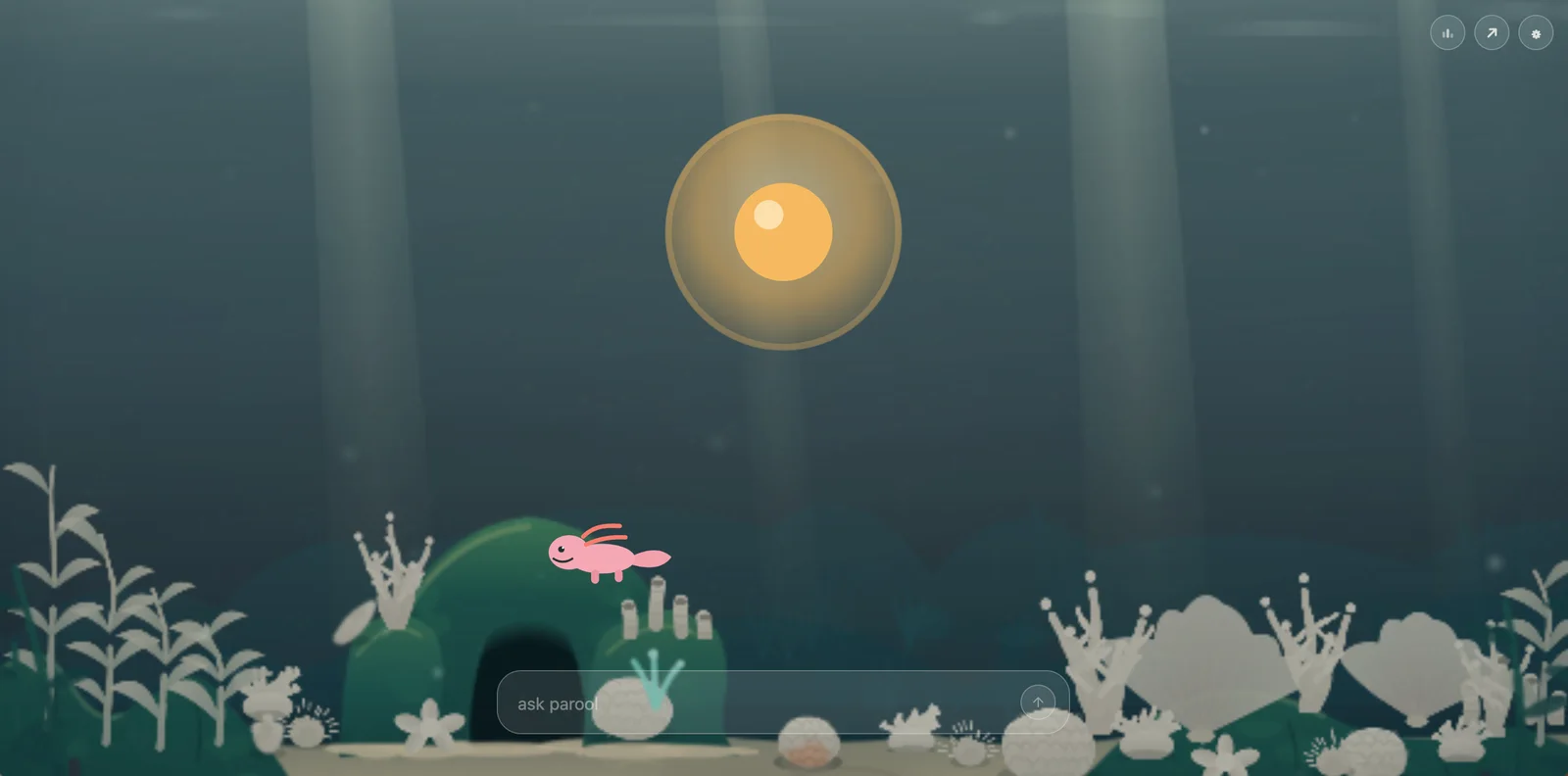
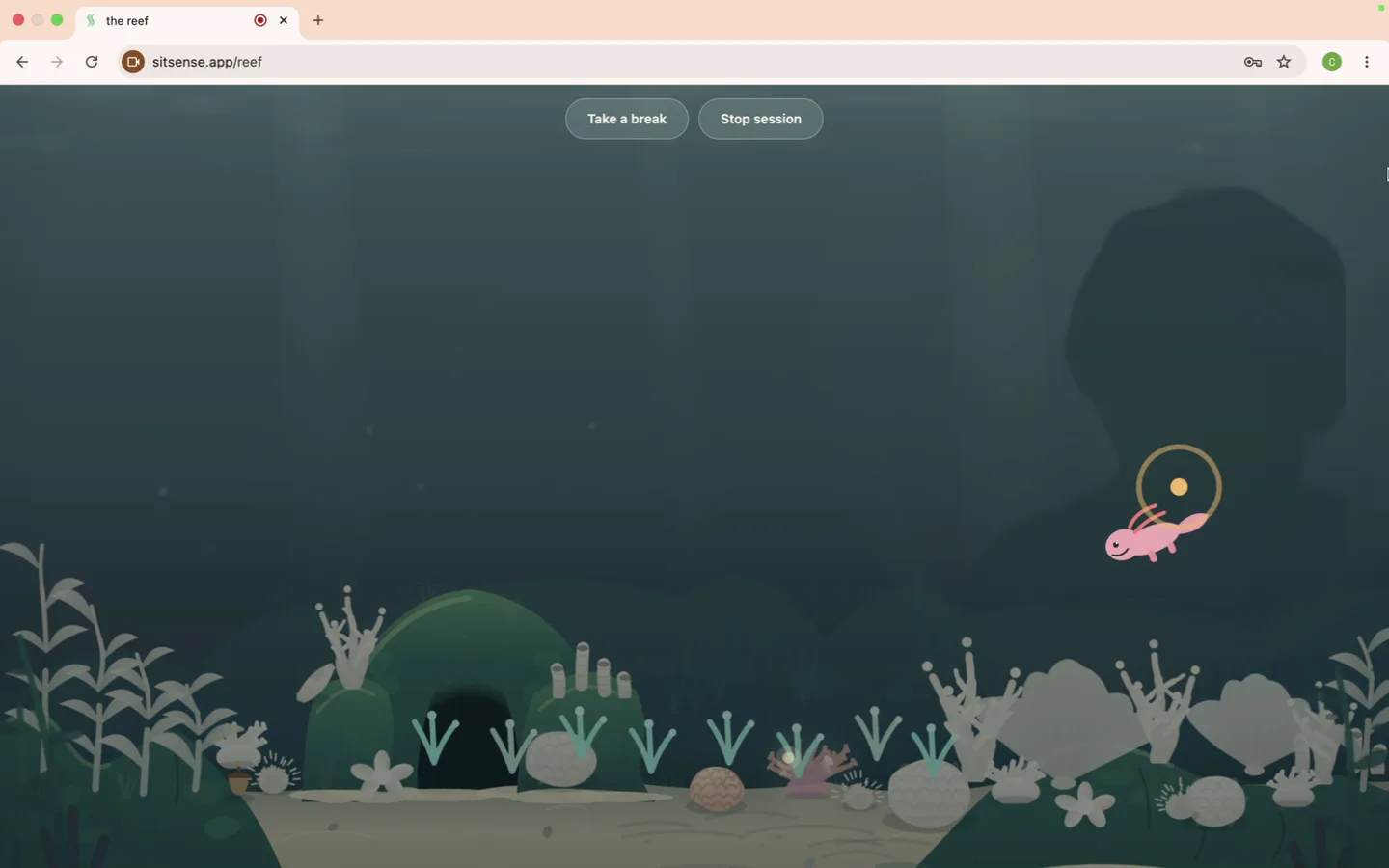
You hatch an axolotl. You name her. She takes you down to a coral reef that is completely bleached — every object in it grey and dormant, including the reef's own coral, from the moment you arrive.
She remembers what it looked like, and she can bring it back. She just cannot work in the dark.
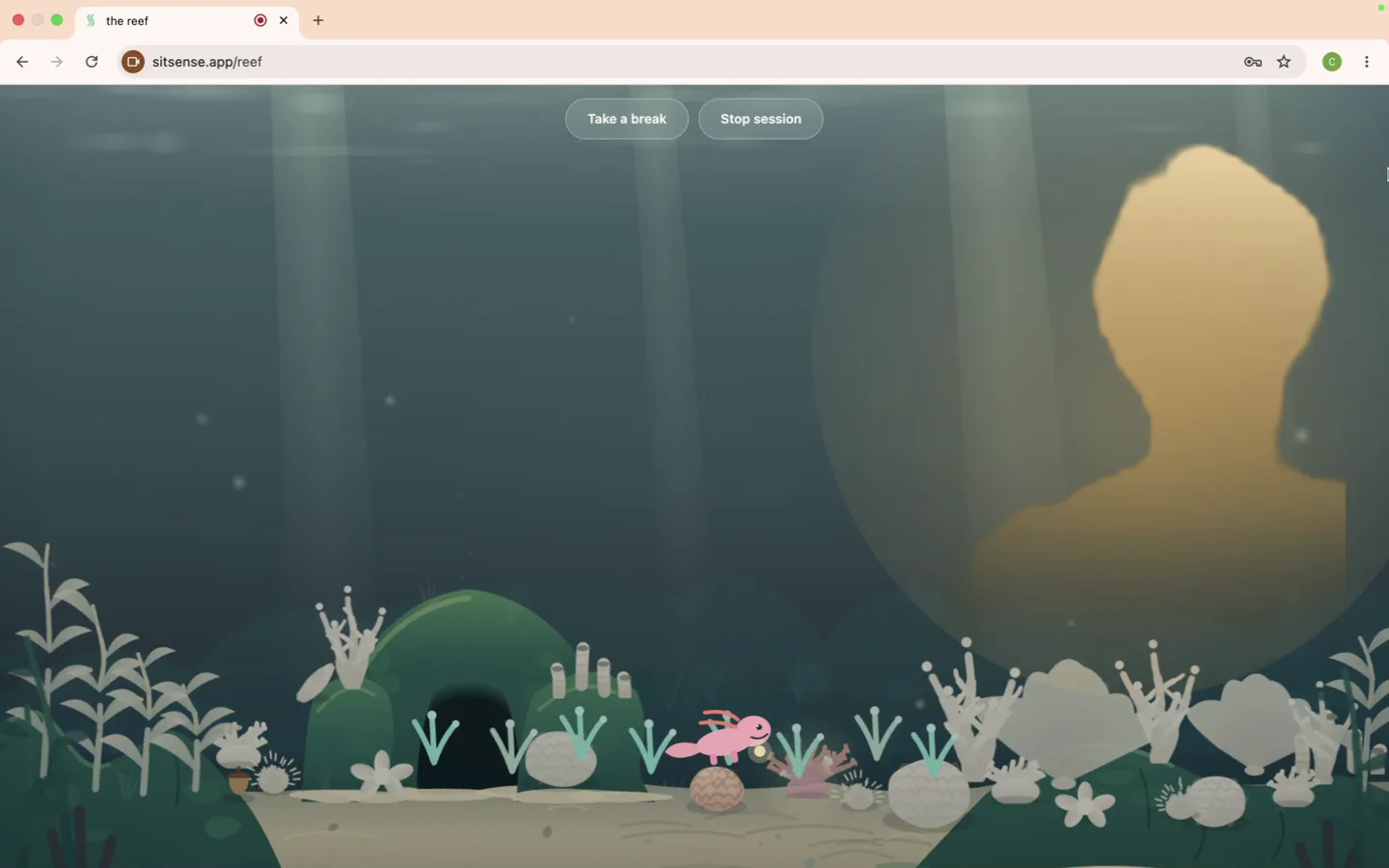
Sitting well is the only thing that makes light. That is the entire input. When your posture is good the water brightens and she works — visibly, on one specific dormant object at a time. When you drift, the light dims, she sets down what she was holding, and she comes to find you.
She is the one doing everything. Every gain in that world is her action, and none of it is possible without you. That mutual dependence is the mechanic: she can fill a reef with grey things and never revive one; you can make light all day with nobody to spend it on. Neither of you is sufficient, which is the part the old design was missing entirely.
There is no meter, no ring, no percentage and no pool of light gathering in a corner. What you read during a session is her — whether she is working or whether she has come over to you. And the progress signal is simply that the reef looks different than it did: there is always exactly one thing today's light went into, and when it finishes she moves to the next. You can tap any other dormant object to send her there instead.
What it is built on
None of the measurement changed. The same seven metrics — neck angle, craniovertebral angle, trunk angle, shoulder slope, forward head position, head tilt and neck rotation — are read by the same pose model at the same thresholds. All we changed is what they are pointed at.
The camera never leaves your machine. Pose estimation runs on-device, in the browser tab, via MediaPipe. No frame is uploaded, stored or transmitted, and what reaches our server after a session is seven numbers. There is nothing to download and no hardware to wear.
It also recalibrates at the start of every session rather than storing a baseline once. Cameras move, chairs change, and a stored band quietly drifts wrong. Recalibrating each time is quick, and it means "tall" is measured against your own tall rather than against a clinical ideal you may not be built to reach.
The small things
When your posture drifts she does not speak straight away. She swims over and watches for about ten seconds first, and only says something if it holds. Noticing should come before commenting, and a coach that reacts to every reach for a coffee cup is one you learn to ignore.
What she says when she does speak is one line, about the one joint that actually moved, and it is one of seven hand-written strings. No model runs during a session — nothing leaves the machine, there is no latency, and her voice cannot drift into something that sounds like an assistant.
Around forty-five minutes she heads for the surface and asks you to come up. The break earns you nothing, deliberately. Because the daily light is capped, sitting through it gains you nothing either, so there is no incentive to skip it. She asks because she needs air.
And nothing decays. Miss a day and the water is still; nothing resets, nothing is taken away, and nobody counts at you. Come back after a week and she rushes the glass — that moment gets more animation than anything else in the product, because the return is the only thing that was ever really at risk.
What we are still figuring out
This shipped on 1 August, so it is days old and we would rather say what is thin than have you find out yourself.
After any day you sat, she goes downstream overnight and comes back with something to tell you about your real day — your steadiest hour, how many times you sat. That beat is built and it works, but the writing behind it is currently drawn from a fixed set of shapes rather than genuinely composed. Her memory is the part of this product we think matters most over months, and it is the next thing being built, not a thing we are claiming today.
The pacing is a guess too. How fast an object should come back, how often she should find something new, how long a first reef should last — those are starting numbers waiting on real use, and they will move.
What we are confident about is the shape. A posture app that grades you has to keep finding new ways to make being graded tolerable. One where sitting well is simply the reason somebody else can do their work does not have that problem. That is the bet, and it is now the whole product.
Questions people ask
- What happened to my posture score, points, streak and leaderboard?
- All of them were removed on 1 August 2026. The score out of 100, the eleven-tier animal ranking, the public leaderboard, posture points and the streak no longer exist anywhere in SitSense. Your past sessions were not deleted — every one of them is still readable under lifetime stats — but the points totals themselves are gone and are not coming back.
- Does SitSense upload my webcam video?
- No. Pose estimation runs entirely on your own device, inside the browser tab, using MediaPipe. No frame is ever uploaded, stored or transmitted. What reaches our server after a session is seven numeric posture metrics and nothing that resembles an image.
- Is SitSense still free?
- Yes, and there is no trial and no credit card. The free version is the whole experience: the companion, the reef, unlimited sessions, the story she brings back after a day you sat, and asking her about your most recent sitting. Pro opens every past session rather than only the last one, plus your full lifetime posture history.
- Do I have to start over if I had an old account?
- No. Your sessions are all kept and your username stays yours. You will go through hatching and naming your companion, because no existing user has ever done that, but the onboarding questions you already answered are skipped.
- How does sitting well actually do anything in the reef?
- Sitting well is the only thing that makes light, and light is the only thing your companion can work by. The seven posture metrics are classified as good, fair or poor exactly as before, and that classification becomes how bright the water is. While the light holds she works on one dormant object at a time, bringing its colour back. When you drift, the water dims and she stops. The light is capped daily, so sitting for ten hours earns no more than one good ordinary day.
- Does SitSense need any hardware or a download?
- Neither. It runs in a browser tab on any device with a webcam — Chrome, Firefox, Safari or Edge on Windows, macOS or Linux. There is nothing to wear, charge or clip on, and nothing to install. A free Chrome extension is also available and needs no account.
Same measurements
Every number above came from a webcam like yours.
104,373 readings from 205 people at their own desks, taken by the same model that would read you.
Free to start. Nothing to install.
Read next
AI Posture Trackers vs Wearables: Accuracy, Cost & Privacy Compared (2026)
Webcam AI tracks 7 posture metrics for free. Wearables cost $80-100 and measure one. Full comparison of accuracy, setup, privacy, and real user results.
How to Fix Posture: The Complete Guide for Computer Users
Science-backed exercises, stretches, and desk setup tips to fix your posture. Includes video tutorials and a 10-minute daily routine for desk workers.
The 2026 State of Posture Report
We measured 104,373 real posture readings from 205 people on webcam AI. Poor posture more than quadruples after 30 minutes of sitting (12.7% → 52.4%), good posture holds only 34.9% of the time, and uneven shoulders — not tech neck — is the #1 flagged problem. Full first-party data, methodology, and a downloadable dataset.
Last updated 2026-08-02